
Burton Step On: A Practical Guide and Review After Several Seasons
Burton's Step On promises to change the way you get into your bindings. Does it deliver? Pros, cons, compatibility, and who should actually buy it.
When Burton launched Step On, the snowboard world reacted with a mix of skepticism and curiosity. Getting into your bindings fast, with no straps and no ratchets? Sounds great on paper. But does it actually work? Is it worth the money? And most of all: is it for you?
We’ve used it for real, not for one demo day but for full seasons. Here’s what we think.
How Step On Works
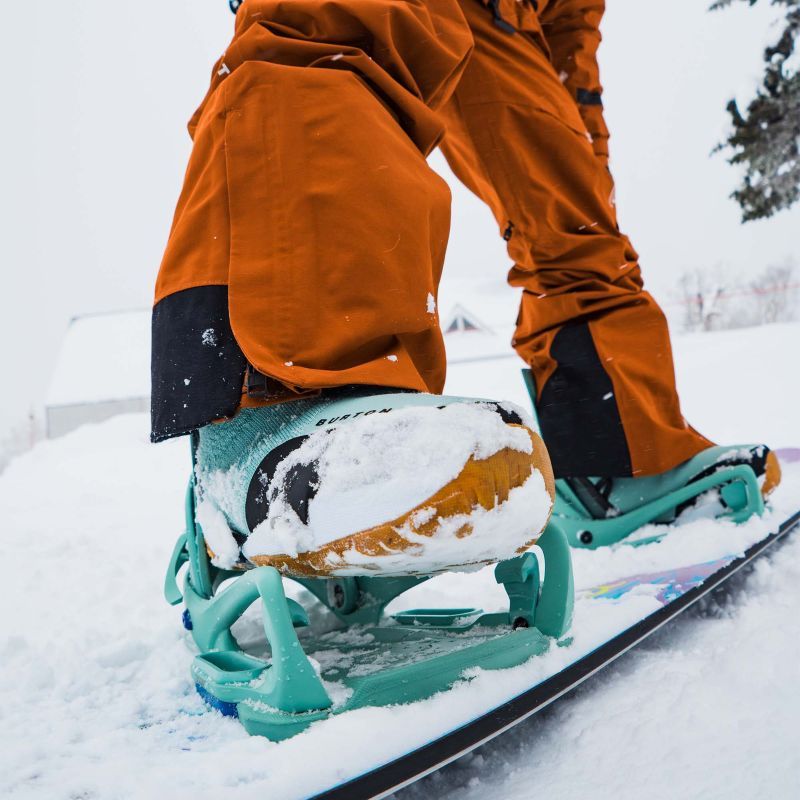
The idea is simple: boots and bindings are designed to work together. Step On boots have three cleats, two on the sides of the toe and one at the heel, and the binding has the hooks and heel clip that lock them in. You get off the chairlift, set your heel in first, then press your toe down: click, you’re in. To get out, you lift the release lever on the side of the heelcup.
No straps, no adjusting, no sitting in the snow at -15°C with frozen gloves.
Pros: What Actually Works
Speed This is the number one advantage, and it’s not overhyped. You get off the lift and you’re ready in 3 seconds. Over a 20-run day, that’s minutes saved every time you set off. And not having to fight your straps at the top of a freezing chairlift takes a real weight off your mind.
Easy in bad weather With thick gloves and numb hands, strapping into regular bindings is a pain. With Step On there’s nothing fiddly to do. It works with any glove.
Response and power transfer This is where a lot of people are surprised. Against all expectations, Step On transfers power from your ankle to the board well. There’s none of the “play” you’d expect from a strapless binding. On groomers and in the park, the response is solid.
Easier on lifts You take your back foot out for the chairlift (just like with regular bindings) and click back in at the top in a second. No fumbling with your boot while everyone else has already dropped in.
Cons: The Limits You Should Know
Compatibility: the main issue Step On isn’t a universal system: Step On boots work only with Step On bindings, and vice versa. It’s not Burton-only, though: Union (Atlas Step On, Atlas Pro Step On, Astra Step On) and Nitro make Step On bindings, and Nitro and DC make Step On boots. You’re locked into the Step On system, not into the Burton brand.
If a part breaks, the spare comes from your binding’s brand (Burton also sells Step On parts online): check that it’s available before your trip.
Price A complete Step On setup (boots + bindings) costs quite a bit more than an equivalent strap setup. Burton Italy 2026/27 price list: adult Step On bindings from €280 (Step On) to €470 (Step On X); Cartel X €350, Genesis €400. Adult Step On boots from €340 (Highshot/Waverange) to €700 (X Pro); Photon Step On €490, Ion Step On €610. So getting into the system costs about €620 (not counting deals).
Not ideal for serious off-piste In our experience, Step On is at its best on groomers and in the park. For freeride in deep snow, the most demanding riders tend to prefer strap bindings with very stiff highbacks, which let you fine-tune the response down to the millimeter. Step On doesn’t offer the same level of customization. For the backcountry, Burton also makes Step On Split splitboard bindings (€550, Burton Italy 2026/27 price list), so Step On isn’t ruled out off-piste; still, many freeriders prefer straps for fine-tuning.
Snow build-up in the bindings In some conditions (wet snow, temperatures around 0°C) snow can pack into the binding hooks and make stepping in less smooth. It doesn’t happen often, but it happens.
Who Should Buy It
Step On is for you if:
- You ride groomers and the park most of the time
- You hate wasting time strapping in, and your friends always end up waiting for you at the top of the lift
- You’re willing to invest in the system and stick with it
- You have hand or finger mobility issues (arthritis, etc.) that make regular straps hard to manage
- You’re an intermediate rider who wants convenience without giving up too much performance
It’s not for you if:
- You mostly ride off-piste and freeride
- You already have a setup that works and don’t want to start over
- Your budget is tight: the extra money you’d spend on Step On could go toward a better board
- You want full freedom to choose any boots and bindings in the future
Verdict
The Burton Step On does what it promises: it gets you into your bindings faster and with less hassle. This isn’t marketing. It’s a system that really works and makes a day on the slopes noticeably more enjoyable.
The downsides are the lock-in and the price. Before you buy, ask yourself whether you’re willing to stick with Step On for years. If the answer is yes, it’s a purchase you won’t regret.
Sources
- Burton: Step On® - Instant Connection System (Step On FAQ, Italy store)
- Burton: Step On® collection, Burton Italy store (2027 line, EUR prices)
- Burton: Step On® collection, Burton Italy store, page 2 (Photon, Ion, Step On Split)
- Burton: Men's Burton Step On® Splitboard Bindings 2027
- Union Binding Company: Atlas Pro Step On® Men's Snowboard Binding
- Union Binding Company: Atlas Step On® Men's Snowboard Binding
- Union Binding Company: Astra Step On® Women's Snowboard Binding
- Nitro Snowboards: The 2027 Nitro Step On® Mens Bindings
- Nitro Snowboards: Step On® collection 26/27 (Nitro Step On boots and bindings)
- Nitro Snowboards: Step On® - How Step On works (digital manual)
- DC Shoes: Men's Judge Step On® Snowboard Boots
- Burton: Snowboarding tools and spare parts (Italy store)